In this article
- The short answer
- Where most businesses start
- When ready-made software is the right choice
- Five signs you have outgrown it
- Three real examples
- IMMO23: from WordPress to an agency CRM
- Idyllic Tour Vibes: bookings without a marketplace
- HireMe: a job portal built around its business model
- What does a custom system cost?
- How to decide: a quick checklist
- Final thoughts
Most businesses in Mauritius start the same way. Bookings arrive on WhatsApp, clients sit in an Excel file, and the website runs on a few WordPress plugins. It works, until one day it does not: the team spends more time working around the tools than working with clients.
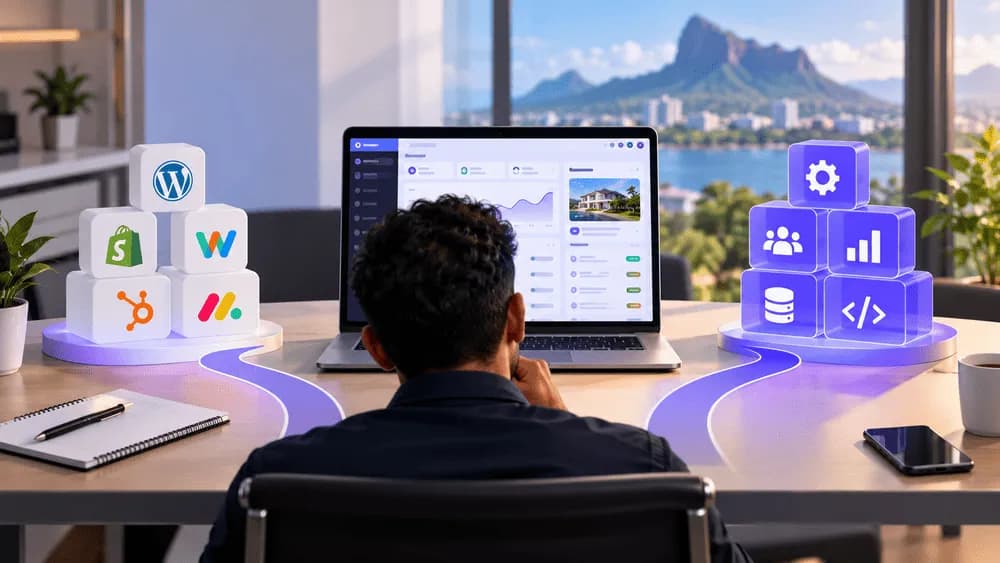
At that point there are two roads. Pay for a ready-made tool such as HubSpot, Zoho, a booking plugin or a marketplace, or build a system that fits exactly how your business works. Both can be the right answer. This guide helps you tell which one is yours.
The short answer
Choose ready-made software when your process is standard, your team is small and you need something working this week. Choose a custom system when the tool forces you to change how you work, when commissions or per-user fees keep growing with your business, or when your data is scattered across several tools that do not talk to each other.
Where most businesses start
None of these are mistakes. They are the cheapest way to get going:
- Excel or Google Sheets for clients, stock or bookings
- WhatsApp and email as the order book
- WordPress plugins for listings, bookings or job offers
- Marketplaces and platforms that bring customers but take a commission on every sale
- Subscription software such as a CRM or a booking tool, paid per user, per month
The trouble starts when the business grows and the tools do not.
When ready-made software is the right choice
I build custom systems for a living, and I still tell many businesses not to. Ready-made software is usually the better option when:
- Your process is standard. A sales pipeline, a newsletter or simple appointments: thousands of businesses work the same way, and good tools already exist.
- Your team is small. Two or three users on a monthly plan cost far less than a build.
- You are still testing the idea. Use a ready-made tool to learn what you really need, then decide.
- Your budget is tight. A custom system is an investment. If it would stretch you, wait.
Five signs you have outgrown it
- Workarounds everywhere. Extra spreadsheets, copy-pasting between tools, a notebook for what the software cannot handle.
- Commissions eating your margin. Every booking or sale through a marketplace costs a percentage, forever.
- The same data in five places. The client is in the CRM, the booking in a plugin, the invoice in Excel, and nobody is sure which one is right.
- The tool decides how you work. You change your process to fit the software instead of the other way round.
- No way to add what you need. The feature that would save you hours each week does not exist, and the plugin cannot be changed.
If three or more of these sound familiar, a custom system is worth a serious look.
Three real examples
IMMO23: from WordPress to an agency CRM
The real estate agency had outgrown its WordPress website. A property belongs to an owner, is assigned to an agent, may have a rental contract with an end date, and has to be published on several portals. Plugins could not handle those relations properly.
I rebuilt it as a custom platform and CRM sharing one database. Around 5,000 listings were migrated, each property is entered once and published to the website and external portals, and upcoming rental contract expiries are flagged automatically. Old URLs were redirected, so search traffic was not lost in the move. Read the IMMO23 case study.
Idyllic Tour Vibes: bookings without a marketplace
The tour company had no website. A booking marketplace would have taken a commission on every reservation, and ready-made plugins rarely handle daily limits per activity and adult/child pricing cleanly.
The custom booking platform lets travellers choose a date, book and pay online, day and night. Daily limits make overbooking impossible, and every payment goes straight to the business. Read the Idyllic Tour Vibes case study.
HireMe: a job portal built around its business model
A new recruitment business needed a platform before it could launch. Instead of a job board template where candidates upload CVs in every possible layout, the platform uses structured profiles, so employers can compare candidates side by side.
It has three dashboards, for job seekers, employers and admins, plus employer packages and advertising spaces built in from day one. Read the HireMe case study.
What does a custom system cost?
More than a ready-made subscription in the first year, and often less over time. In my website cost guide, custom platforms start from around MUR 150,000. The price depends on:
- The number of user types and dashboards (staff, clients, partners, admins)
- Payments and integrations such as payment gateways, portals, accounting or email
- Data to migrate from an old website, spreadsheets or another tool
- How much you want in the first version
My advice: start with the smallest version that removes your biggest problem, then add features as the business grows. Compare the cost with what you pay today in subscriptions, commissions and lost time over three years, not just with a monthly fee.
How to decide: a quick checklist
- Do you pay commissions or per-user fees that grow with every sale or new team member?
- Does your team re-enter the same information in more than one place?
- Have you changed how you work just to fit a tool?
- Is there a feature you need that no tool offers?
- Will you still be running this process in three years?
Mostly no: stay with ready-made software and use it well. Mostly yes: a custom system is likely to pay for itself.
Final thoughts
Ready-made software is the right start for most businesses. A custom system makes sense when your way of working is what sets you apart and the tools keep getting in its way. The goal is not to build software for its own sake, but to stop paying, in money and in hours, for tools that do not fit.
Not sure which side you are on? See web application development, or contact me for a free chat about how your business works today.